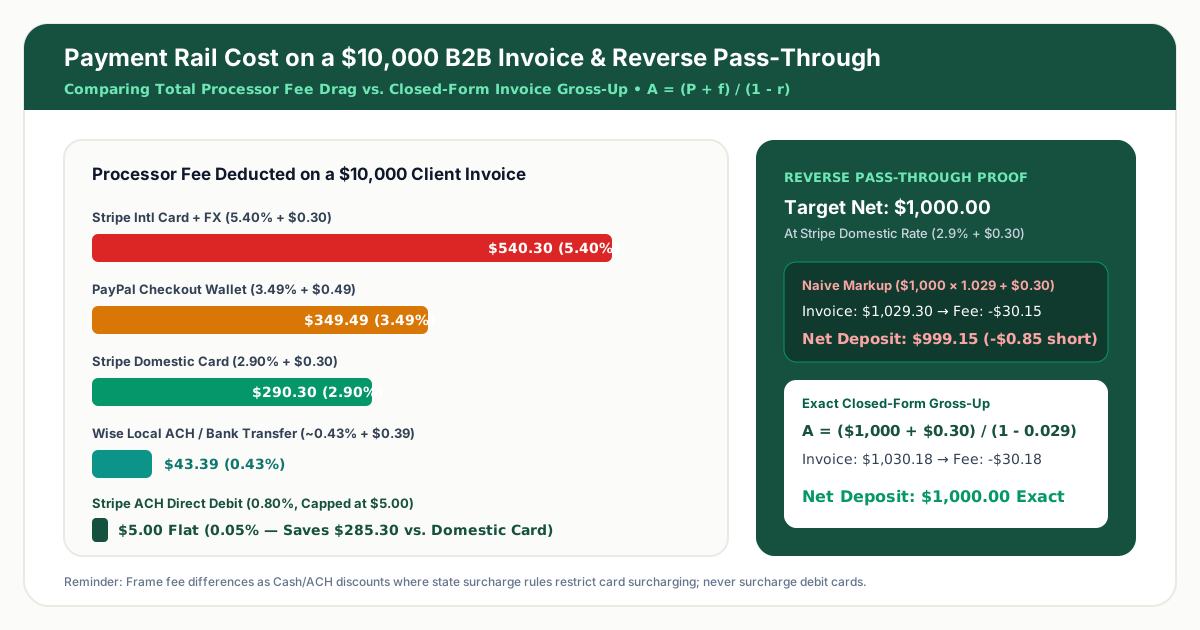
The Mathematical Flaw in Adding a Flat Percentage
The most common mistake freelancers make when attempting to pass processing fees is multiplying their fee by the processor percentage and adding it as a line item. For example, on a $1,000 invoice with a 2.9% + $0.30 fee, many invoice $1,029.30.
However, the payment processor assesses their 2.9% cut against the entire gross transaction ($1,029.30), not your baseline $1,000. 2.9% of $1,029.30 is $29.85, plus $0.30 fixed fee equals $30.15 total fee. After the fee is deducted, you receive $999.15, leaving you short.
The mathematically correct closed-form equation to net target amount P at processor rate r and fixed fee f is:
Gross Invoice (A) = (P + f) / (1 - r)
- Grossing up naively loses money on every transaction due to fee compounding.
- Payment processors charge their percentage fee on the entire transaction amount, including added fees.
- Using the reverse gross-up formula in our Stripe & PayPal Fee Optimizer calculates the exact gross total for zero-slippage settlement.
Current Payment Gateway Fee Schedules in 2025–2026
Merchant processors maintain steep tier spreads between credit cards, branded wallet buttons (PayPal Checkout), international cards, and bank transfers. Understanding the baseline schedule lets you steer high-ticket invoices toward $5-capped ACH rails.
| Platform & Rails | Domestic Rate | International / Cross-Border | Fixed Fee | Payout Speed |
|---|---|---|---|---|
| Stripe Standard Credit Cards | 2.90% | 4.40% (+1.5% intl) / 5.40% (+FX) | $0.30 | 2 business days |
| Stripe ACH Direct Debit | 0.80% (capped at $5.00) | N/A (U.S. USD only) | $0.00 | 3 to 5 business days |
| PayPal Card / Checkout Wallet | 2.99% card / 3.49% wallet | +1.50% cross-border | $0.49 | 1 business day |
| Square Online & Invoicing | 2.90% | 3.50% – 4.50% | $0.30 | Next business day |
| Wise Business Local Transfer | 0.43% avg | 0.65% – 0.85% mid-market FX | $0.39 – $0.50 | Instant / 24 hours |
State Surcharge Laws vs. Cash / ACH Discounting Rules
Passing credit card processing fees directly to clients requires adherence to both card network operating rules (Visa, Mastercard, American Express) and state consumer protection statutes.
Under Visa and Mastercard merchant operating rules, surcharges cannot exceed your actual cost of acceptance and are strictly capped at 3.0% (lowered from the historic 4.0% cap). Surcharging is also strictly prohibited on debit cards, even when processed without a PIN.
Best Practice: To remain 100% compliant across all 50 states—including disclosure-sensitive jurisdictions like California, New York, Massachusetts, and Connecticut—frame your pricing as a Cash / ACH Discount. Quote your standard project rate (inclusive of card handling) and offer a 3% discount when paid via ACH Direct Debit or wire. See our full ACH vs. Credit Card Processing Guide for implementation steps.
- Visa/Mastercard rules strictly cap credit card surcharges at 3.0%.
- Never apply surcharges to debit card transactions; it violates Durbin Amendment & card network rules.
- Cash/ACH discounting is universally legal across all 50 states when clearly disclosed upfront.
Recommended Contract & Invoice Clauses + Tax Reconciliation
To eliminate awkward client pushback and invoice disputes, embed fee transparency into your Master Services Agreement (MSA) before sending your first invoice.
Sample clause: 'Payment Terms: Standard project pricing reflects payment via ACH Direct Debit or Domestic Bank Wire. Clients electing to settle invoices via corporate or personal credit card receive a clearly itemized 3.0% card handling adjustment—or may pay the standard net invoice fee-free using the ACH instructions attached.' Always verify current state statutes (including California SB 478, New York GBL § 518, Connecticut, and Massachusetts rules) and your payment processor's terms before enabling surcharges.
At tax time, remember that both passed-through client payments and retained Stripe/PayPal processing cuts appear inside Form 1099-K Box 1a gross receipts. Report the full gross billed amount on Schedule C Line 1 and deduct all retained merchant fees on Line 10 ('Commissions and fees') so your net taxable profit matches your actual bank deposits. Calculate exact gross-up totals cleanly using the Stripe & PayPal Fee Optimizer.
Elena: Brand Identity Designer
Elena negotiates a $7,500.00 project fee for an international client rebranding. The client requests to pay via corporate credit card on Stripe (2.9% + 1.0% FX/cross-border tier). Elena needs to net exactly $7,500.00 without surrendering a processor haircut.
Agreed project fee required to clear into checking account
2.9% base card rate + 1.0% conversion spread (4.4%–5.4% for international cards)
Loss if invoicing flat $7,500 (client pays $7,500, Elena nets $7,207.20)
Exact mathematical formula to account for fee-on-fee compounding
Amount Elena invoices to the client
3.9% ($304.38) + $0.30 transaction fixed fee
100% of Elena's target fee preserved to the penny
Stripe & PayPal Fee Optimizer
Input your desired net payout, select your payment gateway, and instantly get the exact gross invoice total needed to cover 100% of processing cuts.