Why the Generic 'Save 30%' Advice Over- or Under-Withholds
Every freelance forum repeats the blanket rule: 'Set aside 30% of every check for taxes.' In reality, your true effective tax rate depends dramatically on three levers: your business expense ratio, your state income tax rate, and whether you hold a W-2 job or Solo 401(k).
A contractor netting $60,000 in Texas (0% state tax) after $10,000 of expenses often owes closer to 21% of gross revenue. Conversely, a single freelancer netting $220,000 in California or New York City—where federal, Schedule SE, and 9.3%–13%+ state/city taxes stack—can easily owe 37% to 41% of net profit! Saving a blind 30% leaves a California consultant $15,000+ short in April while starving a Texas beginner of working capital.
| Gross 1099 Revenue | 0% Tax State (TX/FL/WA) | 5% Tax State (IL/MA/CO) | High-Tax State (CA/NYC) |
|---|---|---|---|
| $60,000 | 18% – 20% | 22% – 24% | 24% – 27% |
| $100,000 | 20% – 22% | 24% – 26% | 28% – 31% |
| $150,000 | 22% – 24% | 26% – 28% | 31% – 34% |
| $250,000+ | 24% – 27% | 28% – 31% | 35% – 39% |
The Three-Account Business Banking Architecture
Never run business revenue, operating overhead, and IRS tax money out of a single checking account. Separating cash flow into three purpose-built accounts takes under 30 minutes at modern online business banks (or paired checking + HYSA/Treasury accounts) and eliminates mental accounting:
1. Income & Operating Checking Account: Every client ACH, Stripe payout, and check lands here. Pay software subscriptions, subcontractors, and recurring business bills from this account—and issue a dedicated business debit/credit card strictly for Schedule C expenses. 2. Dedicated Tax Reserve Vault (HYSA or Brokerage T-Bill Account): On the 1st and 15th of each month—or via automated percentage split rules—sweep your calibrated tax percentage (e.g., 27%) out of Operating Checking. Never touch this balance except to pay IRS Direct Pay, EFTPS, or your state revenue portal. 3. Owner Pay / Personal Checking: Transfer a consistent biweekly 'owner draw' to your personal household account. Smoothing uneven freelance invoices into a predictable personal paycheck eliminates lifestyle creep during peak months.
- Separate business checking creates an audit-clean Schedule C ledger automatically.
- Automated sweep rules prevent accidentally spending tax reserves on equipment or slow months.
- Check FDIC sweep limits ($250k) and transfer cutoffs (typically 1–2 business days before April 15 / June 15).
Earning Yield on Quarterly Tax Reserves Without Liquidity Risk
Because quarterly Form 1040-ES installments sit in your possession for 30 to 120 days between client invoicing and IRS due dates, letting $15,000 to $50,000 sit idle in a 0.01% checking account forfeits meaningful risk-free yield.
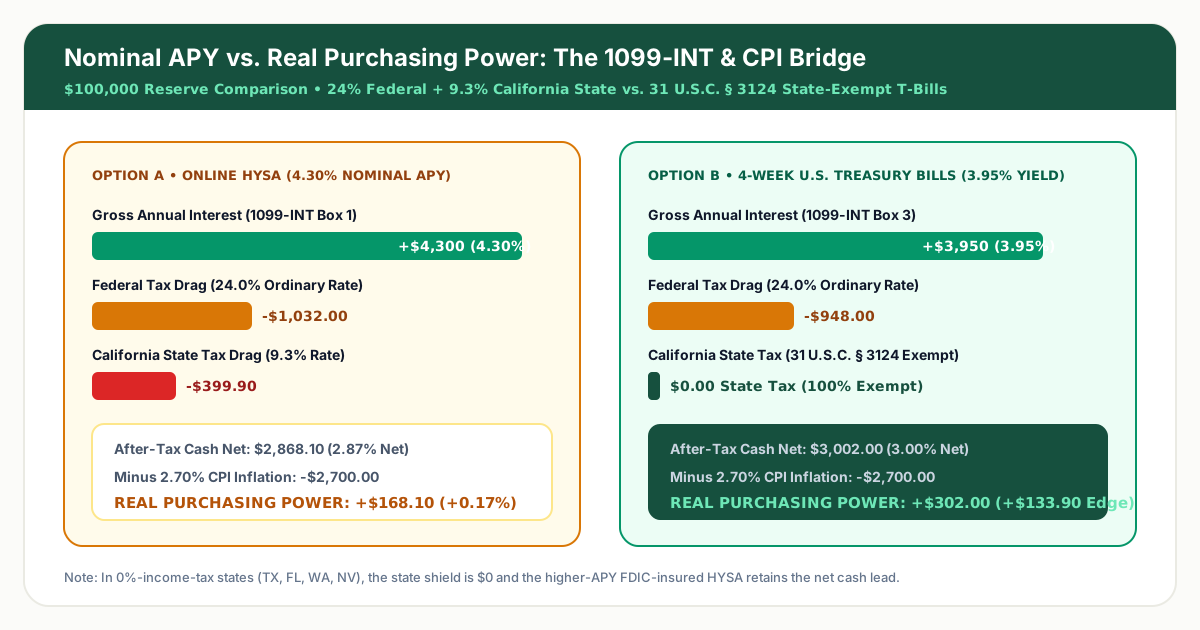
In zero-income-tax states (Texas, Florida, Washington), an FDIC-insured High-Yield Savings Account earning ~4.00%–4.35% APY offers instant liquidity with no maturity lockups. In high-income-tax states (California, New York, New Jersey, Massachusetts), buying 4-week U.S. Treasury Bills timed to mature in the week before April 15, June 15, September 15, and January 15 avoids state income tax entirely under 31 U.S.C. § 3124. Model the real net yield in our HYSA Wealth vs. Inflation Shield.
The 10-Minute Pre-Deadline Quarterly Calibration Habit
Ten days before each quarterly tax deadline (April 5, June 5, September 5, and January 5), compare year-to-date net profit against your prior-year Form 1040 Line 24 Safe Harbor target. If revenue has surged well ahead of projections, keep your Form 1040-ES payment anchored to your 100%/110% prior-year safe harbor while leaving the surplus inside your Tax Reserve Vault—earning interest until April 15 rather than making an interest-free loan to the Treasury. Recalibrate your exact target anytime with our 1099 Freelance Tax Estimator.
Zoe: Independent UX Researcher (Chicago, IL — 4.95% Flat State Tax)
Zoe projects $140,000 gross 1099-NEC revenue with $14,000 in Schedule C business expenses ($126,000 net profit) during 2026, billed unevenly across the four quarters (Q1 $18k, Q2 $46k, Q3 $24k, Q4 $52k).
$140,000 gross receipts minus 10% ($14,000) business overhead
Deductible 50% ($8,901.62) lowers federal & Illinois AGI to $117,098.38
After $16,100 std deduction & $20,199.68 Section 199A QBI ($80,798.70 taxable)
4.95% on ($117,098.38 AGI minus $2,775 IL personal exemption)
29.08% of net profit, or 26.18% of every gross invoice dollar
27% of each gross deposit covers 100% of taxes + $1,155 surplus buffer
Passive interest earned between client payout dates and 1040-ES transfers
1099 Freelance Tax Estimator
Compute your overall effective tax rate across federal, Schedule SE, and state brackets so every invoice transfer matches your real liability.