How the Fed Funds Rate Dictates Bank APYs Across 2025–2026
The Federal Reserve sets the target range for the Federal Funds Rate—the overnight lending rate commercial institutions charge each other. As the FOMC eased down from 5.25%–5.50% peaks in 2025 and later adjusted the target range to 3.75%–4.00% (reaffirmed by a 10–2 FOMC vote on October 28, 2026), online banks adjusted deposit rates in lockstep.
Unlike traditional brick-and-mortar banks paying 0.01%–0.05% APY, online High-Yield Savings Accounts track short-term Treasury and Fed funds benchmarks within 48 to 72 hours of FOMC policy shifts, keeping competitive HYSAs clustered between 4.00% and 4.50% APY in late 2026.
- October 2026 FOMC target range stands at 3.75%–4.00%, anchoring competitive HYSA yields around 4.00%–4.50%.
- HYSA APYs remain variable and adjust without prior customer notice.
- Traditional big-bank checking remains near 0.01%, leaving real purchasing power deeply negative.
The 1099-INT Tax Trap: Ordinary Income vs. Capital Gains
Many savers mistakenly assume bank interest is taxed like long-term capital gains (0%, 15%, or 20%). In reality, under IRC § 61(a)(4), all interest income earned on savings accounts, certificates of deposit (CDs), and money market accounts is treated as ordinary income.
If you earn $120,000 as a freelancer, your top marginal federal tax bracket is 24%. Add state income tax (ranging from 0% in Texas to 9.3%+ in California), and you surrender 24% to 33% of every dollar your HYSA produces. In early January, your bank issues Form 1099-INT, and that interest flows directly into your Form 1040 Schedule B.
| Nominal HYSA APY | 12% Bracket Net Yield | 22% Bracket Net Yield | 24% Bracket Net Yield | 32% Bracket Net Yield |
|---|---|---|---|---|
| 5.00% | 4.40% | 3.90% | 3.80% | 3.40% |
| 4.50% | 3.96% | 3.51% | 3.42% | 3.06% |
| 4.25% | 3.74% | 3.32% | 3.23% | 2.89% |
| 4.00% | 3.52% | 3.12% | 3.04% | 2.72% |
| 3.50% | 3.08% | 2.73% | 2.66% | 2.38% |
The Inflation Wedge: Calculating True Real Return
Earning interest that merely keeps pace with inflation does not build wealth—it merely prevents balance degradation. The rigorous formula for Real Net Purchasing Power Return is:
Real Return Rate = [Nominal APY x (1 - Combined Marginal Tax Rate)] - Inflation Rate
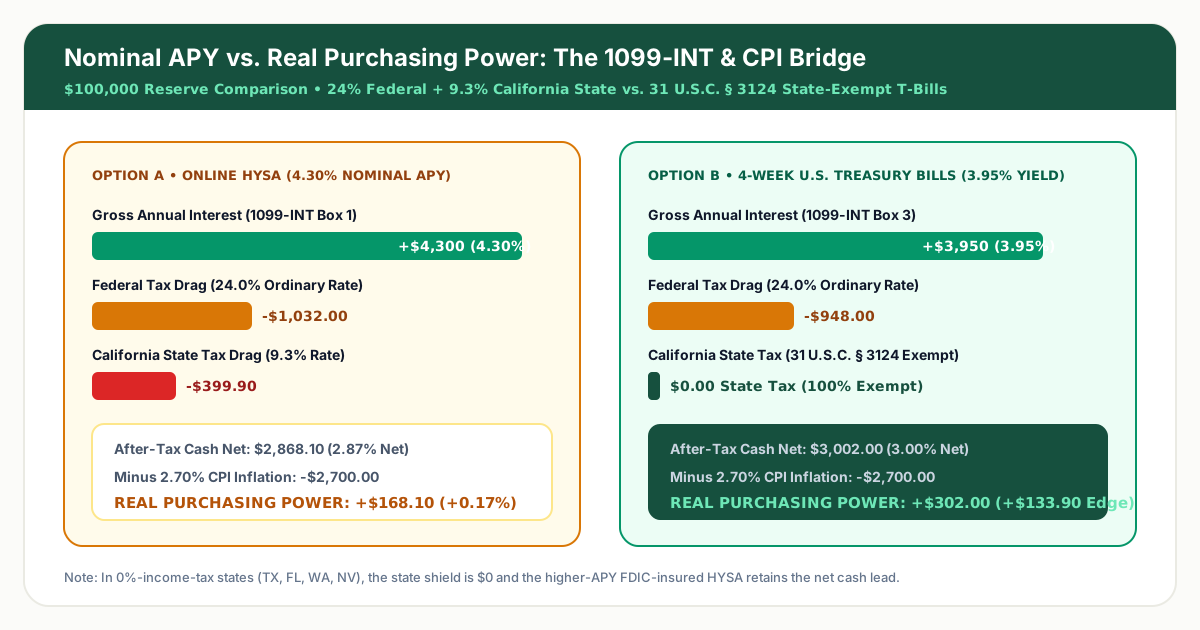
When a bank offers 4.00% APY, an investor in the 24% federal + 5% state tax bracket keeps 2.84% net. If CPI inflation runs at 2.8%, their real net yield is +0.04%—virtually zero economic expansion. Solopreneurs holding six-figure cash reserves must model this tax drag inside our HYSA Wealth vs. Inflation Shield.
Smarter Cash Strategies: Treasury Bills and CD Ladders
Solopreneurs looking to protect yields have two proven alternatives to standard HYSAs:
1. U.S. Treasury Bills (T-Bills): Yields on 4-week to 26-week Treasury bills are exempt from all state and local income taxes under 31 U.S.C. § 3124. See our detailed HYSA vs. 4-Week T-Bills vs. Money Market After-Tax Guide for break-even state math.
2. Fixed-Rate CD Ladders: Certificates of Deposit lock in yields for 6 or 12 months, providing a yield floor if future FOMC meetings pivot back toward easing.
Modeling FOMC Rate Cuts & Avoiding Excess Cash Drag
Because bank HYSA APYs reprice within days of every Federal Open Market Committee announcement, stress-testing your emergency reserve under a 100 bps rate shift is essential before locking into multi-year household budgets. If the FOMC trims target rates from 3.75%–4.00% down toward 2.75%–3.00% while inflation lingers near 2.6%, a freelancer in a 29% combined federal-plus-state bracket earns just 2.13% after tax—resulting in a -0.47% annual loss of real purchasing power.
That arithmetic highlights the hidden opportunity cost of hoarding overly large checking or HYSA balances beyond 6 to 9 months of lean runway: once your tax-reserve vault and emergency buffer are fully funded, excess idle cash steadily loses ground after Form 1099-INT taxation unless evaluated against real after-tax yield benchmarks.
Marcus: Independent Management Consultant
Marcus holds a $60,000 liquid cash reserve (6 months of operational runway and emergency reserves) in a High-Yield Savings Account earning 4.25% APY. Marcus is in the 24% federal marginal bracket and pays 5% state tax (29% combined).
6 months liquid operating emergency buffer
Yielding $2,550.00 in gross annual interest
Taxes due via Form 1099-INT at ordinary income rates
Effective after-tax nominal yield of 3.018%
Loss of constant-dollar purchasing power across the $60,000 principal
Actual purchasing power increase over the entire year
HYSA Wealth vs Inflation Shield
Input your savings balance, APY, marginal tax bracket, and projected inflation to discover if your cash is growing or losing real purchasing power.