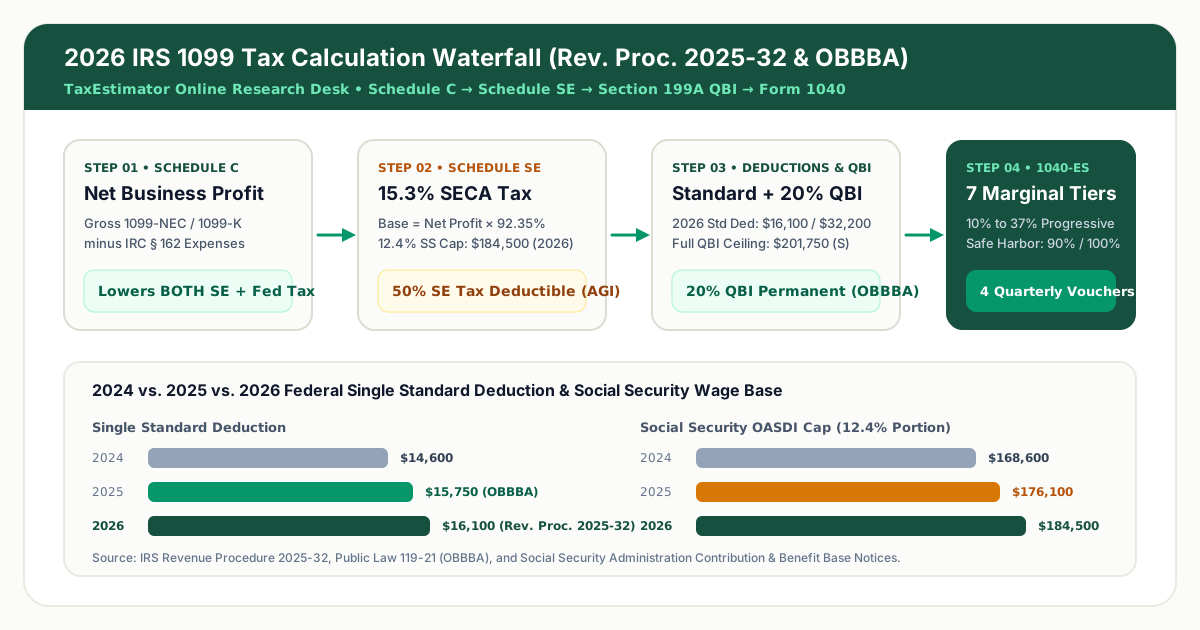
The 2.8% Inflation Adjustment & OBBBA Mid-Year Standard Deduction Boost
Under Internal Revenue Code Section 1(f), the IRS adjusts marginal individual income tax brackets annually using C-CPI-U. For Tax Year 2025, IRS Revenue Procedure 2024-40 widened brackets by roughly 2.8% across the board—before Public Law 119-21 (OBBBA, enacted July 4, 2025) added an extra mid-year boost raising the 2025 standard deduction to $15,750 Single ($31,500 Married Filing Jointly, $23,625 Head of Household).
For 2026 planning, see our updated 2026 IRS Tax Brackets & Standard Deduction Guide, which details the $16,100 single standard deduction and $184,500 Social Security cap under Rev. Proc. 2025-32.
- 2025 standard deduction increased under Rev. Proc. 2024-40 ($15,000) and then retroactively raised by OBBBA to $15,750 Single ($31,500 Married Filing Jointly).
- Top 37% tax rate starts at $626,350 for single filers ($751,600 married joint) in 2025.
- Self-Employment tax (15.3%) remains unaffected, while the 2025 Social Security taxable wage cap stood at $176,100 (rising to $184,500 in 2026).
| Marginal Tax Rate | 2024 Taxable Income Bracket | 2025 Taxable Income Bracket | Bracket Width Expansion |
|---|---|---|---|
| 10% | $0 to $11,600 | $0 to $11,925 | +$325 sheltered at 10% |
| 12% | $11,600 to $47,150 | $11,925 to $48,475 | +$1,000 widened |
| 22% | $47,150 to $100,525 | $48,475 to $103,350 | +$1,500 widened |
| 24% | $100,525 to $191,950 | $103,350 to $197,300 | +$2,525 widened |
| 32% | $191,950 to $243,725 | $197,300 to $250,525 | +$1,450 widened |
| 35% | $243,725 to $609,350 | $250,525 to $626,350 | +$10,200 widened |
| 37% | Over $609,350 | Over $626,350 | +$17,000 ceiling lift |
Section 199A Qualified Business Income (QBI) Phase-Out Expansion
The Section 199A Qualified Business Income deduction allows eligible pass-through entities (sole proprietorships, single-member LLCs, partnerships, and S-Corporations) to deduct up to 20% of their net qualified business income from federal taxable income. However, for Specified Service Trades or Businesses (SSTBs)—which include software engineers, management consultants, accountants, medical practitioners, lawyers, and performing artists—the deduction begins phasing out once taxable income exceeds statutory caps.
For 2025, single filers enjoyed full 20% QBI deductibility up to $197,300 of taxable income (up from $191,950 in 2024), phasing out completely at $247,300 ($394,600 to $494,600 married joint). Starting in 2026, OBBBA made Section 199A permanent and widened those phase-out bands to $75,000 single and $150,000 joint.
- Single filers maintained 100% QBI deduction rights up to $197,300 in 2025 ($201,750 in 2026).
- Married couples filing jointly maintained 100% QBI rights up to $394,600 in 2025 ($403,500 in 2026).
- Non-SSTB businesses above the threshold claim QBI subject to W-2 wage and property limitations.
Quarterly Estimated Taxes: Calibrating Form 1040-ES Vouchers
Solopreneurs remit federal taxes in four installments throughout the tax year (April, June, September, and January). To satisfy IRS Safe Harbor rules, pay at least 90% of your current year's tax liability OR 100% of your prior year's tax liability (110% if prior-year AGI exceeded $150,000).
Run your exact 2024, 2025, or 2026 figures through our 1099 Freelance Tax Estimator to prevent overpaying interest-free or facing underpayment penalties.
Alex: Freelance Senior Full-Stack Developer
Alex files as Single and projects $120,000 in gross 1099 revenues with $15,000 in qualifying ordinary business expenses, resulting in $105,000 net business profit for both 2024 and 2025.
Gross income minus Schedule C deductible expenses
Unchanged rate, half ($7,418.39) deducted above-the-line for AGI
Initially $15,000 (up +$400 vs. 2024); OBBBA later lifted 2025 to $15,750
Full 20% applies; income is well below the $197,300 phase-out ceiling
Based on 2024 tax year marginal brackets
Reflects expanded bracket thresholds and higher standard deduction
Direct cash kept in pocket due to 2025 bracket widening and OBBBA boost
1099 Freelance Tax Estimator
Compare your 2024, 2025, and 2026 tax liability across Schedule SE, Section 199A QBI deduction, and quarterly 1040-ES vouchers.
Social Security Wage Base Hike: The 15.3% SE Tax Reality Check
While federal income tax brackets widened in the freelancer's favor, self-employment tax creates a countervailing headwind for high earners. The Social Security Administration lifted the maximum taxable earnings limit from $168,600 in 2024 to $176,100 in 2025 (+4.45%), and subsequently to $184,500 in 2026.
Self-employed workers pay the full 12.4% Social Security tax up to this cap (15.3% total SE tax when combining the 2.9% Medicare tax). A freelancer netting at or above $176,100 in 2025 paid up to an additional $930 in Social Security tax compared to 2024, underscoring why accurate quarterly 1040-ES estimation is vital to avoid IRC § 6654 penalties.