The Tax-Equivalent Yield (TEY) Equation: Why Headline APY Lies
Following the Federal Reserve's September 2026 25 bps hike and October 28, 2026 hold at a 3.75%–4.00% target range, short-term Treasury auctions and online bank rates have stabilized into a tight band: 4-week T-Bills yield roughly 3.85%–4.03%, while competitive HYSAs offer 4.00%–4.50% APY.
Most savers compare headline percentages naively. Because U.S. Treasury interest is 100% exempt from all state and local income taxes under federal statute (31 U.S.C. § 3124) while HYSA interest faces both federal and state income tax on Form 1099-INT, the true break-even HYSA APY required to match a Treasury yield is:
Break-Even HYSA APY = T-Bill Yield x (1 - Federal Rate) / (1 - Federal Rate - State Rate)
For a New York City freelancer paying 24% federal plus 10.72% combined NY State + NYC local tax, a 3.95% T-Bill delivers the exact same after-tax cash as a 4.60% HYSA. Conversely, for a Texas or Florida resident paying 0% state income tax, the state shield equals zero—so the higher-APY FDIC-insured HYSA wins outright.
| Domicile Jurisdiction | Top Marginal State/Local Rate | T-Bill After-Tax Net | Break-Even HYSA APY Required |
|---|---|---|---|
| Texas / Florida / Washington (0%) | 0.00% | 3.00% | 3.95% APY (No T-Bill tax edge) |
| Illinois (Flat State Rate) | 4.95% | 3.00% | 4.23% APY (+28 bps required) |
| Massachusetts (Standard) | 5.00% | 3.00% | 4.23% APY (+28 bps required) |
| California (Typical Freelancer) | 9.30% | 3.00% | 4.50% APY (+55 bps required) |
| New York City (State + City) | 10.72% | 3.00% | 4.60% APY (+65 bps required) |
| California High Earner (32% Fed + 11.3% CA) | 11.30% | 2.69% | 4.74% APY (+79 bps required) |
The Money Market Fund Trap in California, New York, and Connecticut
Many freelancers park idle brokerage cash in default 'Government' Money Market Funds (like SPAXX or VMFXX) assuming those funds inherit the state-tax exemption of U.S. Treasuries. That assumption frequently backfires.
Default government money market funds often hold 40% to 65% of their portfolio in overnight repurchase agreements (repos) backed by collateral rather than direct U.S. Treasury obligations. Under state revenue codes in California, New York, and Connecticut, a mutual fund CANNOT pass through ANY state tax exemption to shareholders unless at least 50% of the fund's total assets consist of direct U.S. federal obligations at the close of each quarter!
If a fund holds only 42% direct Treasuries and 58% repos, 100% of its dividends become fully taxable in California, New York, and Connecticut. Residents in those three states must explicitly select 100% Treasury-only money market funds (or short-term Treasury ETFs like SGOV/USFR, or buy 4-week T-Bills directly at zero commission via TreasuryDirect or Fidelity/Schwab).
- Always verify the year-end 'U.S. Government Obligations Percentage' tax supplement issued by your brokerage in February.
- CA, NY, and CT enforce a strict all-or-nothing 50% asset threshold for fund pass-through state exemptions.
- Direct 4-week T-Bills bought at auction or in brokerage accounts bypass expense ratios (0.00% ER) and qualify for 100% state-tax exemption under 31 U.S.C. § 3124.
Liquidity Speed, FDIC vs. Sovereign Backing & Form 1099 Reporting
Before migrating your entire cash fortress into 4-week T-Bills, map your liquidity timing. An HYSA transfers to checking in 1–2 business days with FDIC protection ($250k per depositor/bank). Direct T-Bills held at TreasuryDirect must wait until maturity (up to 28 days for a 4-week ladder; 7 days if staggered across 4 weekly rungs), whereas T-Bills or Treasury ETFs held inside a brokerage settle T+1 on any market day.
At tax time, T-Bill interest arrives on Form 1099-INT Box 3 ('Interest on U.S. Savings Bonds and Treasury Obligations'), which tax software automatically strips from state taxable income—whereas mutual fund Treasury income arrives on Form 1099-DIV and requires you to manually enter your state-exempt percentage! Simulate long-term after-tax inflation decay in our HYSA Wealth vs. Inflation Shield.
Rachel: Senior UX Strategist (San Francisco, CA — 24% Fed + 9.3% CA)
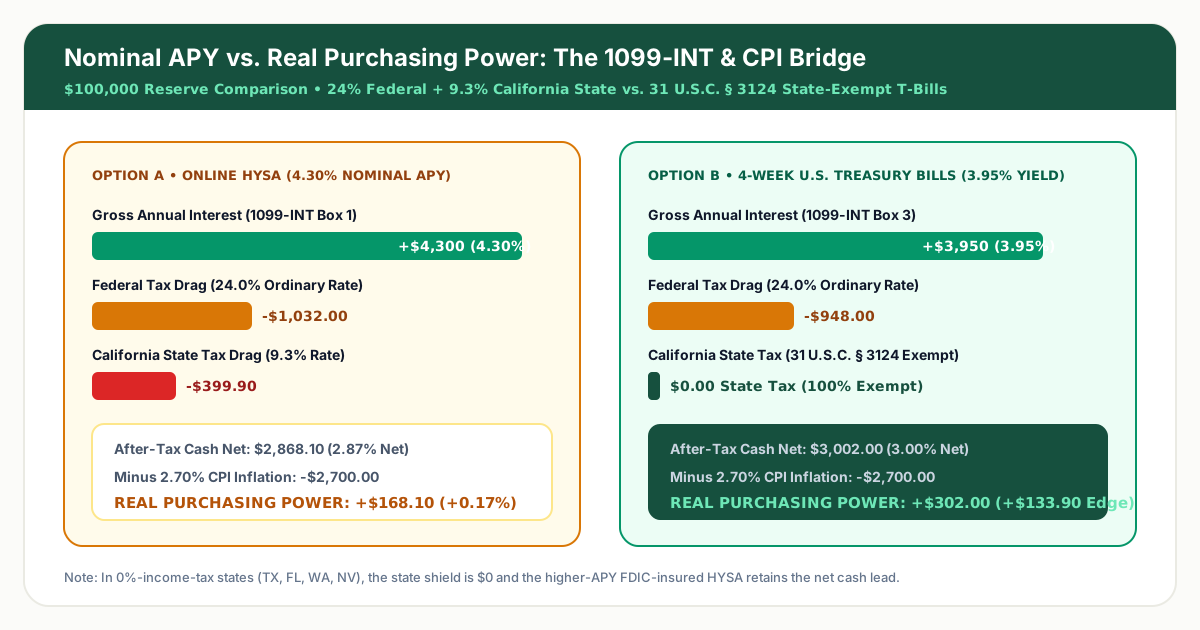
Rachel holds $100,000 in combined quarterly tax reserves and emergency runway in November 2026. Her marginal federal rate is 24% and her California marginal bracket is 9.3% (33.3% combined tax drag on bank interest). She compares a 4.30% APY online HYSA, a 4.05% repo-heavy government money market fund (40% Treasuries), and a 3.95% 4-week U.S. Treasury Bill auto-roll ladder.
Subject to 24% federal + 9.3% California tax (-$1,431.90) = 2.87% net
Reported on Form 1099-INT; full $4,300 taxed by California FTB
Fails CA's 50% Treasury asset threshold; taxed at full 33.3% (-$1,348.65)
Worst option for CA/NY/CT residents when fund holds >50% overnight repos
100% exempt from CA, NY, and local taxes under 31 U.S.C. § 3124
Only 24% federal tax (-$948.00); $0.00 state tax = 3.00% net yield
A California HYSA must pay 4.50%+ APY just to break even with a 3.95% T-Bill
HYSA Wealth vs Inflation Shield
Model your effective marginal federal and state tax rate alongside CPI inflation to test whether your cash reserve actually beats inflation.