OBBBA & Revenue Procedure 2025-32: The Permanent 2026 Bracket Architecture
Before Congress enacted Public Law 119-21—commonly called the One, Big, Beautiful Bill Act (OBBBA)—in July 2025, freelancers faced a scheduled January 1, 2026 tax cliff that would have reverted top individual rates to 39.6%, slashed the standard deduction roughly in half, and eliminated the 20% Section 199A Qualified Business Income (QBI) deduction.
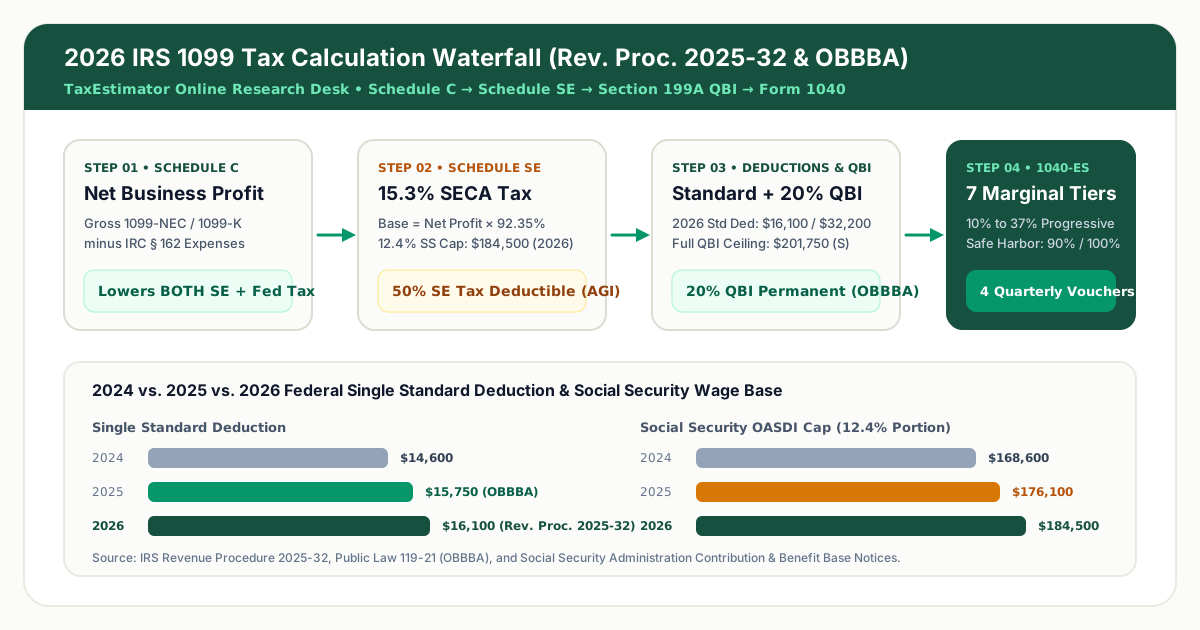
OBBBA permanently locked in the seven-tier bracket structure (10%, 12%, 22%, 24%, 32%, 35%, and 37%), raised the baseline standard deduction (retroactively lifting 2025 to $15,750 Single / $31,500 Joint), and handed the IRS updated C-CPI-U indexing rules implemented in Revenue Procedure 2025-32 for Tax Year 2026. For 2026, the standard deduction rises to $16,100 for Single and Married Filing Separately taxpayers, $24,150 for Heads of Household, and $32,200 for Married Filing Jointly couples.
Because personal exemptions remain permanently set at $0, self-employed workers rely on the expanded standard deduction paired with Schedule C business write-offs and above-the-line Schedule 1 adjustments to compress taxable income before marginal rates apply.
- 2026 Standard Deduction: $16,100 (Single/MFS), $24,150 (Head of Household), $32,200 (Married Filing Jointly).
- Post-OBBBA 2025 Standard Deduction reference: $15,750 Single / $23,625 HoH / $31,500 Joint.
- Personal exemptions remain permanently $0; AMT exemption climbs to $90,100 for single filers ($140,200 joint).
| Marginal Rate | Single Taxable Income | Married Filing Jointly | Head of Household |
|---|---|---|---|
| 10% | $0 to $12,400 | $0 to $24,800 | $0 to $17,700 |
| 12% | $12,400 to $50,400 | $24,800 to $100,800 | $17,700 to $67,450 |
| 22% | $50,400 to $105,700 | $100,800 to $211,400 | $67,450 to $105,700 |
| 24% | $105,700 to $201,775 | $211,400 to $403,550 | $105,700 to $201,750 |
| 32% | $201,775 to $256,225 | $403,550 to $512,450 | $201,750 to $256,200 |
| 35% | $256,225 to $640,600 | $512,450 to $768,700 | $256,200 to $640,600 |
| 37% | Over $640,600 | Over $768,700 | Over $640,600 |
Permanent Section 199A QBI Deduction & Widened 2026 Phase-Out Bands
For sole proprietors, single-member LLCs, and S-Corporation shareholders, the single largest legislative win in OBBBA was making the 20% Section 199A QBI deduction permanent while expanding its phase-out corridors starting in 2026.
Previously, Specified Service Trades or Businesses (SSTBs)—including software consultants, management advisors, writers, accountants, physicians, and attorneys—lost their QBI deduction over a compressed $50,000 window ($100,000 joint). Under Rev. Proc. 2025-32 for 2026, full QBI eligibility extends up to $201,750 of taxable income for Single and Head of Household filers ($201,775 Married Filing Separately) and $403,500 for Married Filing Jointly. Moreover, the phase-out corridor widens by 50% to $75,000 for Single/HoH (completing at $276,750) and $150,000 for Married Filing Jointly (completing at $553,500).
Starting in 2026, Section 199A(i) also introduces a $400 minimum QBI deduction floor for active business owners reporting at least $1,000 of qualified business income, ensuring small side-hustlers retain baseline pass-through relief.
- 2026 full QBI ceiling: $201,750 Single/HoH ($403,500 Married Filing Jointly).
- Expanded phase-out corridor: $75,000 Single (full phase-out at $276,750) and $150,000 Joint (full phase-out at $553,500).
- Pre-tax Solo 401(k) and Form 7206 health insurance contributions reduce QBI income base, so model marginal savings in the 1099 Freelance Tax Estimator.
Action Checklist for Year-End 2026 Tax Calibration
With Q4 2026 estimated payments due January 15, 2027, solopreneurs should run a final year-end reconciliation in November or December rather than waiting until April. Check whether pre-tax retirement funding (up to $24,500 employee deferral plus employer share in a Solo 401(k)) or Section 179 equipment purchases before December 31 will pull taxable income back inside the $201,750/$403,500 Section 199A QBI threshold.
Use the 1099 Freelance Tax Estimator with Tax Year 2026 selected to compare your exact Schedule SE, QBI, and state liabilities before locking in your final Form 1040-ES transfer.
Maya: Independent Cloud Infrastructure Architect
Maya files as Single in a zero-income-tax state and generates $210,000 in gross 1099-NEC consulting revenue during 2026 with $18,000 in Schedule C software, travel, and cloud-lab expenses, yielding $192,000 in net business profit.
$210,000 gross receipts minus $18,000 ordinary business expenses
Entire amount falls below the $184,500 Social Security wage cap for 2026
$21,986.69 Social Security + $5,142.05 Medicare; 50% ($13,564.37) reduces AGI
Adjusted upward under Rev. Proc. 2025-32 (up from $15,750 post-OBBBA 2025)
20% of $162,335.63 taxable income before QBI; safely below the $201,750 threshold
Blended across the 10%, 12%, 22%, and 24% Rev. Proc. 2025-32 single brackets
26.51% effective federal tax rate on $192,000 net profit
1099 Freelance Tax Estimator
Calculate your exact 2026 federal brackets, $184,500 Social Security cap, Section 199A QBI deduction, and Form 1040-ES quarterly vouchers.
The $184,500 Social Security Wage Base: Planning for Higher SE Tax
While federal income tax brackets became slightly more forgiving in 2026, the Social Security Administration raised the OASDI contribution and benefit base from $176,100 in 2025 to $184,500 in 2026—a 4.77% increase ($8,400).
Self-employed contractors pay both the employer and employee shares of Social Security (12.4%) on 92.35% of net Schedule C profit up to $184,500. That pushes the maximum 2026 self-employment Social Security tax to $22,878.00 (up $1,041.60 from 2025's $21,836.40 ceiling). Remember that any W-2 wages earned during 2026 consume this $184,500 cap first: if a dual-income engineer earns $130,000 on a W-2 and $80,000 net on a side 1099 contract, only $54,500 of 1099 SE earnings face the 12.4% Social Security tax, while the full $73,880 ($80,000 x 92.35%) still owes the uncapped 2.9% Medicare tax.
High earners must also budget for the 0.9% Additional Medicare Tax (Form 8959) once combined W-2 plus 92.35% SE earnings cross $200,000 Single ($250,000 Married Filing Jointly).