Bracket Stacking & Section 199A QBI Eligibility on Side Income
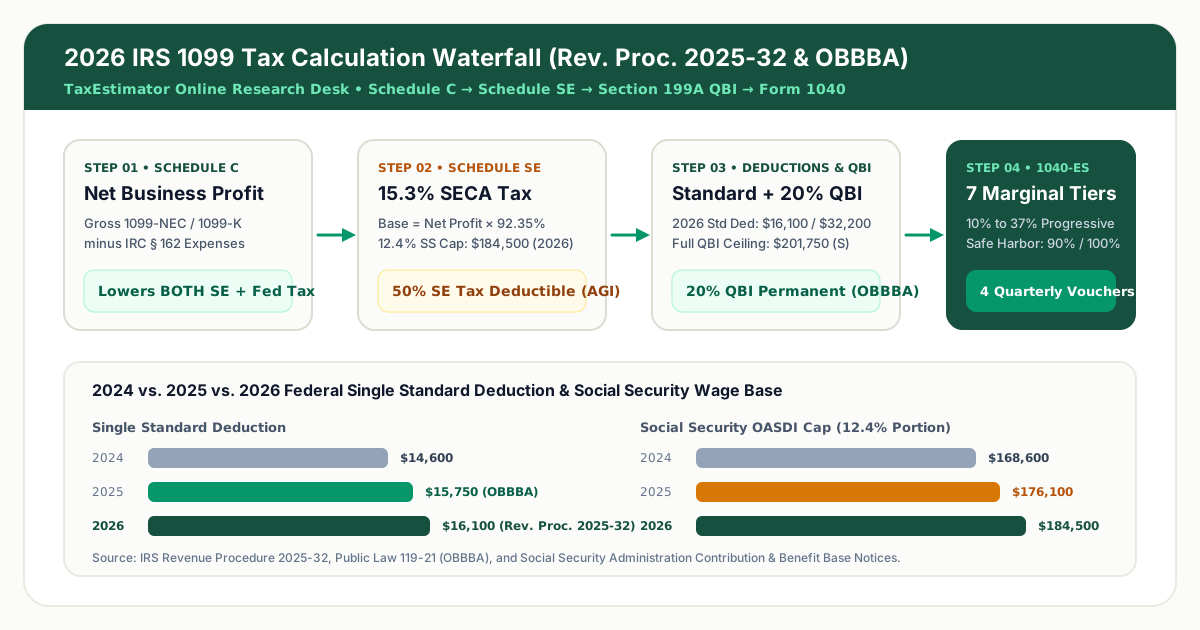
While your W-2 salary helps cap your Social Security tax, it creates the opposite effect on federal income tax rates. Because W-2 earnings already use up your standard deduction ($16,100 Single / $32,200 Joint in 2026) and your 10% and 12% brackets, every dollar of net 1099 profit stacks directly onto your highest marginal bracket (22%, 24%, 32%, or higher).
Fortunately, side-hustle profit still qualifies for the permanent 20% Section 199A Qualified Business Income (QBI) deduction—even though W-2 wages themselves receive 0% QBI. Just remember that your combined W-2 + 1099 taxable income determines whether you cross the 2026 QBI phase-out start ($201,750 Single / $403,500 Joint). Contributing to a pre-tax workplace 401(k) or side Solo 401(k) lowers taxable income across both buckets, potentially preserving your full 20% QBI deduction.
| W-2 Base Salary | 1099 SS Cap Room Left | Schedule SE Tax | Marginal Fed Bracket | Combined 1099 Tax Rate |
|---|---|---|---|---|
| $50,000 | $134,500 (Full SS applies) | $5,651.82 | 22% (QBI-adjusted 17.6%) | 31.1% |
| $110,000 | $74,500 (Full SS applies) | $5,651.82 | 24% (QBI-adjusted 19.2%) | 32.6% |
| $165,000 | $19,500 (Partial cap) | $3,489.56 | 24% (QBI-adjusted 19.2%) | 27.4% |
| $190,000 | $0 (100% SS exempt!) | $1,071.26 (+0.9% Addl) | 32% (QBI phase-out zone) | 30.8%–35.4% |
Using Form W-4 Line 4(c) Instead of Quarterly Form 1040-ES Vouchers
Instead of tracking four separate Form 1040-ES estimated payments and worrying about uneven seasonal side-hustle cash flow, dual W-2 + 1099 workers have a major administrative advantage: Form W-4 Line 4(c) ('Extra withholding').
Under IRS Publication 505 and IRC § 6654(g), federal taxes withheld from W-2 paychecks are treated as having been paid equally (25% per quarter) throughout the year—regardless of when in the calendar year the withholding occurred. If you earn an unexpected $30,000 consulting bonus in October, boosting W-4 Line 4(c) on your November and December paychecks can satisfy IRS Safe Harbor retroactively without filing Form 2210 Schedule AI. Model your exact combined liability first inside the 1099 Freelance Tax Estimator.
Jordan: Full-Time W-2 Cloud Engineer + Side 1099 Advisor (Texas)
Jordan earns a $155,000 W-2 salary (where his employer withholds FICA) plus $50,000 in side 1099-NEC consulting revenue with $5,000 in Schedule C business expenses ($45,000 net profit) as a Single filer in Texas (0% state tax) in 2026.
$155,000 W-2 salary + $45,000 net Schedule C profit
$184,500 OASDI cap minus $155,000 W-2 wages already taxed at FICA
$12,057.50 exceeds the $184,500 ceiling and skips 12.4% SS tax
$3,658.00 Social Security + $1,205.17 Medicare (saves $1,495.13 via W-2 cap)
20% of $42,568.41 (net profit minus 50% SE deduction); under $201,750 threshold
24% applied to $34,054.73 QBI-adjusted net side profit
Combined Schedule SE + incremental income tax on 1099 profit
1099 Freelance Tax Estimator
Enter both your W-2 salary and your 1099 revenue side-by-side to see exact Social Security cap savings, Additional Medicare surtax, and net effective tax rate.
How W-2 Wages Interact with the $184,500 Social Security Cap
Many dual-income earners mistakenly assume their side 1099 income faces an automatic flat 15.3% self-employment tax regardless of their day-job salary. Under IRS Schedule SE Part I (Line 8a–8c), W-2 wages that were subject to FICA withholding consume the annual Social Security OASDI wage cap first.
For Tax Year 2026, the Social Security taxable wage base is $184,500 (up from $176,100 in 2025). If your W-2 Box 3 Social Security wages already equal or exceed $184,500, you pay 0.0% of the 12.4% Social Security tax on your entire 1099 consulting profit—owing only the 2.9% Medicare portion (plus the 0.9% Additional Medicare surtax if combined earnings cross $200,000 Single or $250,000 Married Filing Jointly).
Notice also what happens when you hold TWO W-2 jobs vs. one W-2 + one 1099 business: two W-2 employers can accidentally over-withhold Social Security tax (which you reclaim on Schedule 3 Line 11), whereas Schedule SE automatically caps your 1099 Social Security tax up front when you enter your W-2 wages properly.