2026 Solo 401(k) & SEP IRA Statutory Limits Under Notice 2025-67
Under IRS Notice 2025-67 (announced in IR-2025-111), defined contribution limits rise across the board for Tax Year 2026. The employee elective deferral ceiling climbs by $1,000 to $24,500 (up from $23,500 in 2025), while the overall IRC § 415(c) annual additions cap increases to $72,000 (up from $70,000 in 2025), alongside a $360,000 eligible compensation cap.
Age-based catch-up provisions also expand in 2026: participants age 50 or older can add an extra $8,000 (pushing total employee deferrals to $32,500 and total Solo 401(k) capacity to $80,000). Under SECURE 2.0, participants turning ages 60, 61, 62, or 63 in 2026 unlock a special 'super' catch-up of $11,250, raising their total Solo 401(k) ceiling to $83,250.
Crucially, SEP IRAs cannot accept employee elective deferrals or catch-up contributions—leaving solo founders under $360,000 net profit with dramatically less shelter room.
| Feature | 2026 Solo 401(k) | 2026 SEP IRA |
|---|---|---|
| Employee Elective Deferral | $24,500 (up to 100% net SE earnings) | $0 (Not permitted) |
| Employer Profit Sharing | 20% net adjusted SE (25% of W-2) | 20% net adjusted SE (25% of W-2) |
| Total Combined Cap (Under 50) | $72,000 | $72,000 (requires ~$373k Schedule C profit) |
| Age 50+ Catch-Up (50–59, 64+) | +$8,000 (Total $80,000) | $0 (Not permitted) |
| SECURE 2.0 Super Catch-Up (60–63) | +$11,250 (Total $83,250) | $0 (Not permitted) |
| Roth Contribution Bucket | Yes (Employee + SECURE 2.0 Employer) | Optional Roth SEP (limited custodian support) |
| Backdoor Roth IRA Pro-Rata Impact | Zero impact (401(k) excluded from pro-rata) | Blocks tax-free Backdoor Roth conversions |
The 20% Effective Rate Formula & Backdoor Roth Pro-Rata Trap
Many self-employed guides loosely quote '25% of profits' for SEP IRA and Solo 401(k) employer contributions. While 25% applies to W-2 wages inside an S-Corporation, Schedule C sole proprietors and single-member LLCs must compute employer contributions against net adjusted self-employment earnings—defined as Schedule C net profit minus 50% of Schedule SE tax minus the employer contribution itself.
Mathematically, dividing 0.25 by 1.25 compresses the effective cap to exactly 20% of (Net Profit minus 50% of SE Tax). That means to hit the $72,000 max in a SEP IRA alone during 2026, a Schedule C contractor needs roughly $373,000 in net profit. With a Solo 401(k), you hit $72,000 around $250,000 in net profit—saving years of compounding.
Furthermore, holding a traditional SEP IRA balance triggers the IRS pro-rata rule (Form 8606) if you ever execute a Backdoor Roth IRA conversion, generating taxable income on every dollar converted. Solo 401(k) assets are completely exempt from the IRA aggregation rule.
- Effective employer limit for Schedule C filers is 20% of (Net Profit - 1/2 SE Tax), not 25% of gross or net profit.
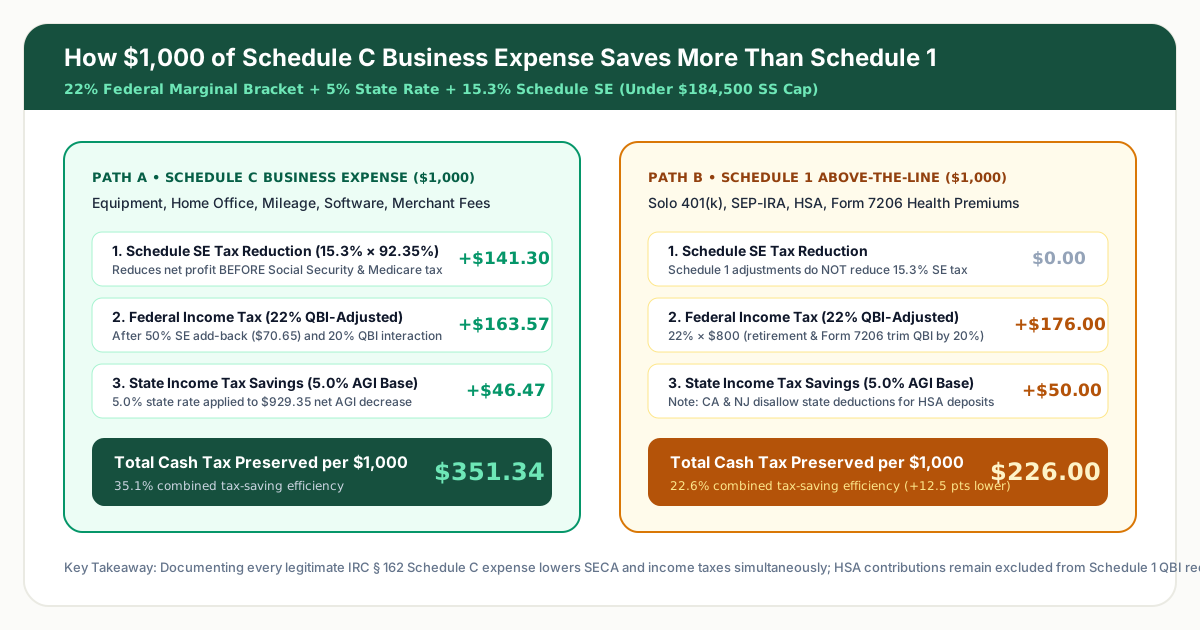
- Pre-tax Solo 401(k) contributions reduce federal/state income tax and AGI, but do NOT reduce 15.3% Schedule SE tax.
- Under SECURE 2.0, you can establish and fund a Solo 401(k) employer contribution—and for sole proprietors, even initial-year employee deferrals—up to your April 15 tax filing deadline (though existing plans still require Dec 31 deferral elections for S-Corps).
Modeling the QBI Tradeoff: Pre-Tax vs. Roth Solo 401(k)
Because retirement plan contributions are deducted when calculating Qualified Business Income under Treas. Reg. § 1.199A-3, every $1,000 you put into a pre-tax Solo 401(k) reduces your 20% Section 199A QBI deduction by $200. In the 22% federal bracket, a $1,000 pre-tax contribution saves $176 in federal income tax (22% x $800) rather than a naive $220. In the 12% bracket, it saves only $96 in federal income tax (an effective 9.6% rate)—often making Roth Solo 401(k) employee deferrals mathematically superior if you sit in the 12% federal band.
Once you climb into the 24%, 32%, or 35% federal brackets—or reside in high-tax states like California or New York—pre-tax Solo 401(k) deductions deliver an immediate 30% to 45% tax arbitrage. Run both pre-tax and zero-contribution scenarios in our 1099 Freelance Tax Estimator to measure your exact marginal bracket drop.
Noah: Independent Software Engineer (Single, Age 38)
Noah earns $120,000 in Schedule C net business profit during 2026 in a 6% state income tax jurisdiction. He wants to maximize pre-tax retirement contributions before year-end and compares opening a SEP IRA against a Solo 401(k).
Deductible 50% of SE tax = $8,477.73; Net Adjusted SE Earnings = $111,522.27
Employer-only contribution; no employee deferral allowed
$24,500 employee elective deferral + $22,304.45 employer profit sharing
More than double the SEP IRA shelter at $120,000 freelance profit
Taxable income $76,337.82 after $16,100 standard deduction & $19,084.45 QBI
Drops Noah out of 22% bracket into 12% bracket ($38,894.26 taxable income)
$3,411+ more in immediate tax savings than maxing a SEP IRA
1099 Freelance Tax Estimator
Plug your 2026 Solo 401(k) or SEP-IRA deferral into the estimator to calculate your net AGI drop, QBI adjustment, and total tax saved.