First Principles: Why a Single-Member LLC Saves Zero Taxes on Its Own
One of the most persistent misconceptions among new independent contractors is that forming a Limited Liability Company (LLC) creates automatic tax write-offs or eliminates self-employment tax. By default, the IRS treats a Single-Member LLC as a disregarded entity for federal income tax purposes.
That means a Sole Proprietorship and a standard Single-Member LLC file the exact same tax forms (Form 1040 Schedule C and Schedule SE), qualify for the exact same business deductions, and pay the exact same 15.3% self-employment tax. An LLC provides valuable state-law liability shielding for your personal assets when properly maintained with separate bank accounts and operating agreements—but on your tax return, it changes nothing unless you actively file Form 2553 to elect S-Corporation tax treatment.
- Sole Proprietorship and default Single-Member LLC have identical federal tax math.
- An LLC is a legal liability wrapper; S-Corp is a federal tax election (Form 2553).
- In states like California ($800/yr) or New York (publication fees), forming an LLC adds recurring entity costs before saving a dime.
How S-Corp Distributions Dodge SE Tax—And the Hidden QBI Penalty
Once you elect S-Corp status (Form 2553) for an LLC or corporation, you become both a shareholder and a W-2 employee of your own company. You must pay yourself a reasonable W-2 salary subject to 15.3% FICA payroll taxes (7.65% employee + 7.65% employer), while remaining net profit passes through on Schedule K-1 free of the 15.3% self-employment tax.
However, under IRC § 199A, W-2 wages paid to an S-Corp shareholder-employee are strictly excluded from Qualified Business Income—only the remaining K-1 net profit qualifies for the 20% QBI deduction! Because a Schedule C sole proprietor receives the 20% QBI deduction on almost their entire net profit (less 50% SE tax), converting $80,000 of profit into an S-Corp W-2 salary destroys up to $16,000 of QBI deduction. At a 22% to 24% marginal bracket, that lost deduction quietly adds $2,900 to $3,800 back onto your Form 1040 income tax bill.
Conversely, for high-earning Specified Service Trades or Businesses (consultants, doctors, attorneys) whose taxable income already exceeds the 2026 QBI phase-out ceiling ($276,750 Single / $553,500 Joint), QBI is already $0—meaning the QBI penalty disappears and S-Corp FICA savings accelerate sharply (plus non-SSTB owners above the threshold actually need W-2 wages to unlock QBI!).
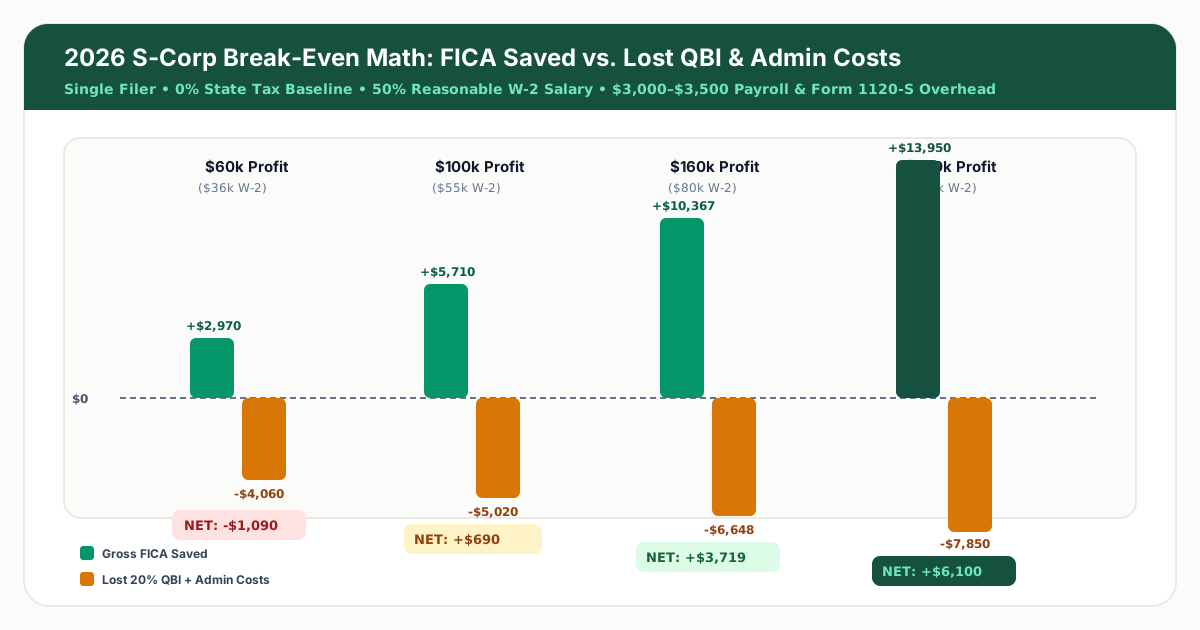
| Net Profit | Reasonable W-2 | Gross FICA Saved | Lost QBI Tax Drag | Est. Admin Costs | True Net S-Corp Gain |
|---|---|---|---|---|---|
| $60,000 | $36,000 | +$2,970 | -$1,060 | -$3,000 | -$1,090 (Loss) |
| $100,000 | $55,000 | +$5,710 | -$1,920 | -$3,100 | +$690 (Break-Even) |
| $160,000 | $80,000 | +$10,367 | -$3,448 | -$3,200 | +$3,719 (Net Gain) |
| $220,000 | $100,000 | +$13,950 | -$4,350 | -$3,500 | +$6,100 (Strong Gain) |
Reasonable Compensation Rules & State-Level S-Corp Surprises
You cannot arbitrarily set your S-Corp salary to $10,000 on $200,000 of consulting profit to dodge payroll taxes. IRS Revenue Ruling 74-44 empowers auditors to reclassify unreasonably low distributions as W-2 wages and assess back payroll taxes plus 100% penalties. A defensible reasonable salary reflects what it would cost to hire someone else to perform your revenue-generating work, backed by Bureau of Labor Statistics or industry salary benchmarks (typically 40% to 60% of net profit for solo practitioners).
You must also price state-level entity friction into your break-even calculation. California levies a 1.5% corporate franchise tax on S-Corp net income (minimum $800/yr). New York City does not recognize federal S-Corp elections at all, subjecting NYC S-Corps to an 8.85% General Corporation Tax! Illinois charges a 1.5% Personal Property Replacement Tax on S-Corp income, and Tennessee taxes S-Corp franchise/excise profits. Always calculate state entity taxes before filing Form 2553.
- Document reasonable compensation annually using BLS occupation wages or RCReports.
- File Form 2553 by March 15 to elect S-Corp status for the current tax year (or rely on Rev. Proc. 2013-30 late election relief if requirements are met).
- S-Corp owners lose Schedule C/Form 8829 home office deductions and must use a written Accountable Plan instead.
Retirement Maximization & When to Pull the Trigger
Another critical factor is retirement capacity: an S-Corp employer profit-sharing contribution is capped at 25% of your W-2 salary (not 20% of total K-1 distributions). If you pay yourself an $80,000 W-2 salary, your employer Solo 401(k) contribution caps at $20,000 (plus $24,500 employee deferral = $44,500), whereas a $160,000 Schedule C sole proprietor can shelter up to $54,239 in 2026.
In general, wait until your consistent net business profit exceeds $105,000 to $120,000 in low-friction states (or $140,000+ in CA, IL, or NYC) before electing S-Corp status. Compare your exact numbers first using the 1099 Freelance Tax Estimator.
Priya: Fractional Product Lead (Texas Domicile)
Priya earns $160,000 net business profit in Texas (0% state income tax, $0 franchise tax below $2.47M) as a Single filer in 2026. She compares remaining a Single-Member LLC (Schedule C) against filing Form 2553 for S-Corp taxation with an $80,000 W-2 reasonable salary.
$22,607.28 SE tax + $18,056.50 federal income tax (captures $26,519.27 QBI)
$6,120 employer FICA + $6,120 employee FICA (saves $10,367.28 in payroll tax)
Gusto/payroll software ($800), Form 1120-S CPA prep ($1,800), FUTA/SUTA ($600)
$160,000 minus $80,000 W-2 minus $6,120 ER FICA minus $3,200 overhead
W-2 wages earn 0% QBI; losing $12,383.27 in QBI adds ~$3,448.06 in income tax
$12,240.00 FICA + $21,504.56 federal income tax + $3,200.00 overhead
Real net savings after QBI drag & admin costs (only 36% of naive FICA headline)
1099 Freelance Tax Estimator
Establish your baseline 15.3% Schedule SE and Section 199A QBI liability before deciding whether an S-Corp election justifies Form 1120-S payroll overhead.