Form 7206 Mechanics: Who Qualifies for the Self-Employed Health Deduction
When buying health insurance out-of-pocket on the ACA Marketplace or private exchanges, self-employed workers are NOT forced to itemize medical expenses on Schedule A (where the 7.5% AGI floor wipes out deductions for most households). Instead, IRC § 162(l) and Form 7206 allow you to deduct 100% of medical, dental, vision, and age-capped long-term care insurance premiums directly above-the-line on Form 1040 Schedule 1, Line 17.
Three strict statutory guardrails govern eligibility:
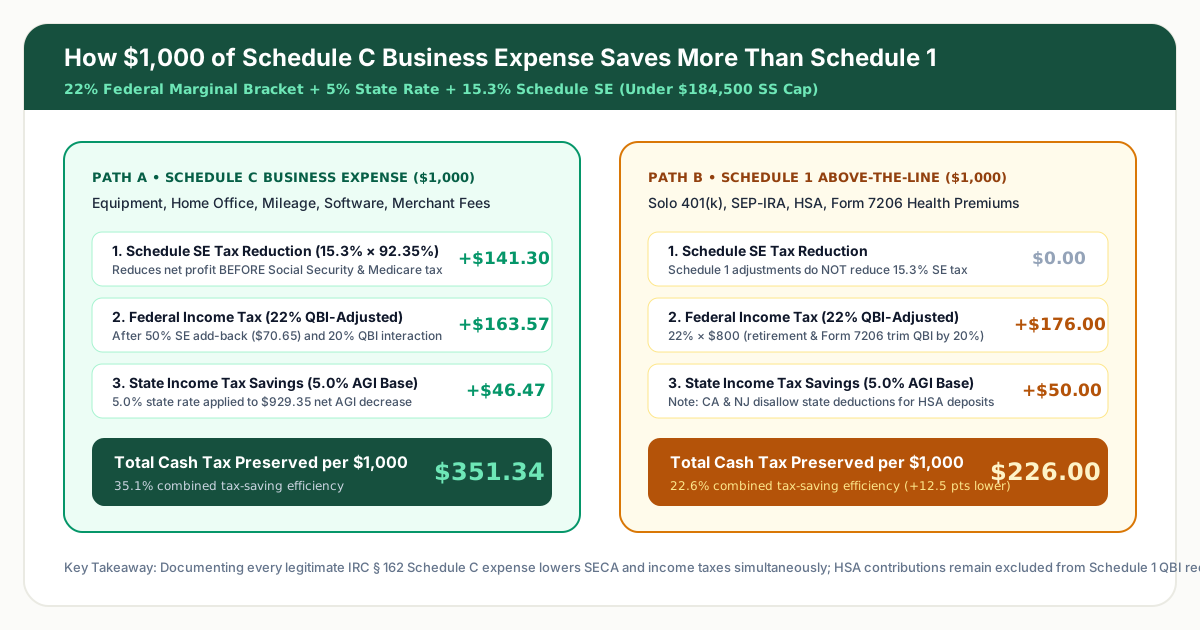
1. Month-by-Month Subsidized Plan Exclusion: You CANNOT claim Form 7206 for any calendar month in which you were eligible to participate in an employer-subsidized health plan—either through a W-2 side job of your own OR through your spouse's employer—even if you declined to enroll. 2. Net Earned Income Ceiling: Your Form 7206 deduction cannot exceed your net Schedule C business profit minus 50% of your Schedule SE tax and minus deductible SEP/Solo 401(k) contributions for that specific business. 3. Schedule SE & QBI Rule: For sole proprietors, Form 7206 premiums do NOT lower your 15.3% self-employment tax, and under Treas. Reg. § 1.199A-3 they DO reduce Qualified Business Income (lowering your 20% QBI deduction).
- Applies to medical, dental, vision, Medicare Part B/D/Medigap, and qualified LTC premiums for you, your spouse, and dependents under age 27.
- Excludes ACA Advance Premium Tax Credit (APTC) subsidies—only your net out-of-pocket premium paid qualifies.
- S-Corporation >2% shareholders must have the corporation pay or reimburse premiums AND include them in W-2 Box 1 (exempt from Boxes 3 & 5 FICA!) to unlock the deduction.
2026 HSA Contribution Limits (Rev. Proc. 2025-19) & Triple-Tax Power
Pairing an HSA-eligible High-Deductible Health Plan (HDHP) with a Health Savings Account gives freelancers the only triple-tax-advantaged vehicle in the U.S. tax code: contributions are tax-deductible above-the-line, invested balances grow 100% tax-free across index funds or T-Bills, and withdrawals for qualified medical, dental, and vision bills are never taxed at any age.
Even better, there is no 'use-it-or-lose-it' rule and no time limit on reimbursement. Savvy solopreneurs pay routine out-of-pocket medical bills using rewards credit cards, archive the itemized PDF receipts, and let their HSA balance compound untouched for decades—withdrawing tax-free whenever liquidity is needed, or taking penalty-free ordinary withdrawals for any reason after age 65 (matching a Traditional IRA).
| Parameter | 2025 Limit | 2026 Limit | Annual Change |
|---|---|---|---|
| HSA Contribution — Self-Only | $4,300 | $4,400 | +$100 |
| HSA Contribution — Family | $8,550 | $8,750 | +$200 |
| HSA Catch-Up (Age 55+) | +$1,000 | +$1,000 | Statutory fixed |
| HDHP Minimum Deductible (Self / Family) | $1,650 / $3,300 | $1,700 / $3,400 | +$50 / +$100 |
| HDHP Max Out-of-Pocket (Self / Family) | $8,300 / $16,600 | $8,500 / $17,000 | +$200 / +$400 |
The California & New Jersey HSA Trap + The S-Corp FICA Exemption
Two state anomalies catch freelancers off guard every spring: California and New Jersey do NOT recognize HSAs as tax-advantaged accounts at the state level. Residents of CA and NJ receive zero state tax deduction for HSA contributions and must manually add back HSA dividends, interest, and realized capital gains on their state tax returns—making Treasury-only funds or low-turnover broad ETFs essential inside CA/NJ HSAs to minimize taxable state churn.
Meanwhile, if you operate as an S-Corporation (>2% shareholder), employer-paid health insurance premiums reported cleanly in W-2 Box 1 (excluded from Social Security and Medicare Boxes 3 and 5 under IRS Notice 2008-1) dodge the 15.3% FICA tax entirely while still qualifying for the Form 7206 deduction—saving an extra ~$1,700 on $11,400 in premiums compared to Schedule C filers. Simulate your baseline health deduction inside the 1099 Freelance Tax Estimator.
Hannah & Leo: Married Freelance Husband-and-Wife Photography Studio
Filing Married Filing Jointly in Colorado (4.4% flat state tax), Hannah and Leo earn $145,000 in net Schedule C profit during 2026. They purchase an ACA Gold/Bronze HDHP family plan ($11,400/yr premiums) with no employer coverage available and contribute the full 2026 family HSA cap ($8,750).
Subject to $20,487.84 SE tax ($10,243.92 deductible half)
100% deducted above-the-line on Schedule 1, Line 17
Rev. Proc. 2025-19 limit (up from $8,550 in 2025)
Reduces AGI from $134,756.08 down to $114,606.08
80% net taxable drop ($16,120) x 22% due to QBI taxable-income cap
Colorado conforms to federal HSA & Form 7206 deductions
Plus permanent tax-free compounding on the $8,750 invested HSA balance
1099 Freelance Tax Estimator
Add your annual medical premiums and HSA contributions to calculate exact AGI compression and 2026 federal tax reductions.