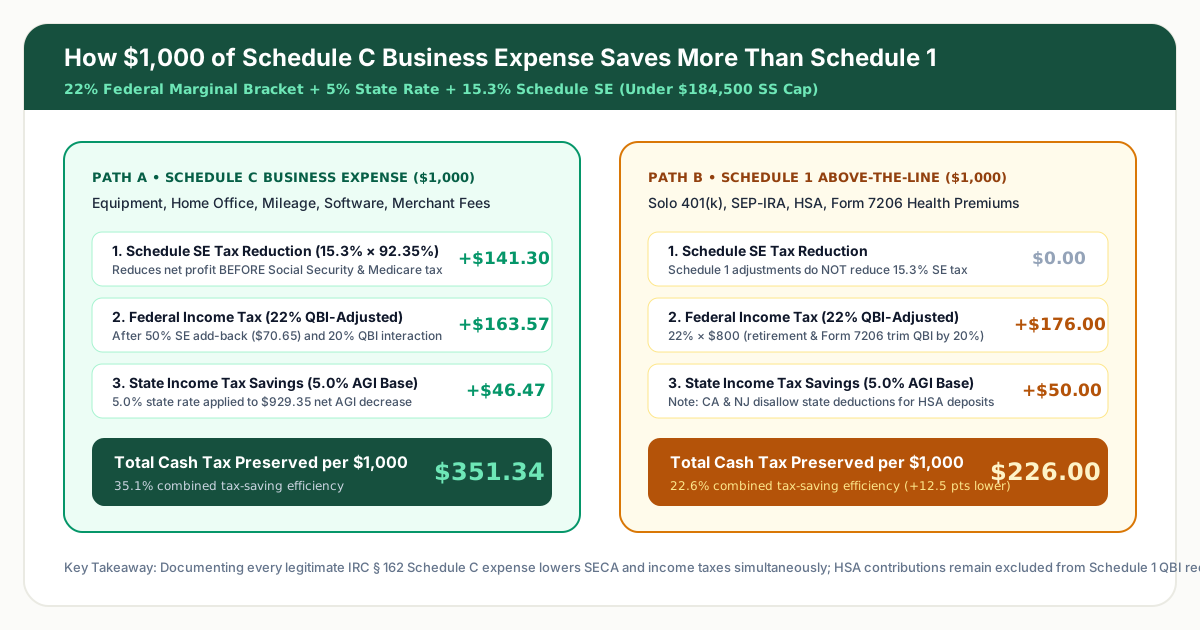
The IRC § 162 Standard: Why Schedule C Beats Above-the-Line Deductions
Under Internal Revenue Code Section 162, freelancers can deduct all ordinary and necessary expenses paid or incurred during the taxable year in carrying on a trade or business. An ordinary expense is common and accepted in your field; a necessary expense is helpful and appropriate, even if not strictly indispensable.
Critically, Schedule C deductions (Lines 8 through 27a and Line 30) outperform personal Schedule 1 adjustments—such as HSA or SEP-IRA contributions—on a dollar-for-dollar basis for taxpayers under the $184,500 Social Security cap. Why? Schedule C deductions reduce your net profit BEFORE Schedule SE computes the 15.3% self-employment tax, whereas personal retirement or health insurance adjustments only reduce income tax after SE tax is locked in.
Keep in mind the mathematical interaction with Section 199A: lowering Schedule C net profit by $1,000 reduces your 15.3% SE tax by $141.30, leaves $929.35 of AGI reduction (after the 50% SE deduction adjustment), trims your 20% QBI deduction by $185.87, and lowers federal taxable income by $743.48. In the 22% federal bracket and a 5% state bracket, that $1,000 Schedule C expense saves $351.33 in total taxes.
- Schedule C deductions reduce BOTH 15.3% Schedule SE tax and federal/state income tax.
- Personal expenses (commuting, standard business attire, non-business meals) remain strictly non-deductible under IRC § 262.
- Segregate business cash flow into a dedicated business checking account and credit card to preserve audit clarity.
Line-by-Line Schedule C Categories & 2026 Deduction Rules
Understanding where expenses sit on Schedule C Part II prevents misclassifications that trigger automated IRS Discriminant Function (DIF) audit scores. High ratios in vague categories like 'Other Expenses' (Line 27a) or unsubstantiated vehicle mileage (Line 9) attract scrutiny, whereas properly categorized software, advertising, contract labor, and professional fees align cleanly with standard NAICS industry benchmarks.
| Schedule C Line | Category | Qualifying Examples | Key Limit / Audit Rule |
|---|---|---|---|
| Line 8 | Advertising | Google/Meta ads, portfolio site hosting, sponsorships | Must promote business; exclude lobbying |
| Line 9 | Car & Truck | Client visits, supply runs, airport travel | 2026 split rate: 72.5¢ (H1) / 76¢ (H2) |
| Line 10 | Commissions & Fees | Stripe, PayPal, Upwork, marketplace fees | Reconcile against gross Form 1099-K receipts |
| Line 11 | Contract Labor | Subcontractors, editors, virtual assistants | Issue Form 1099-NEC if >=$600 via ACH/check |
| Line 15 | Insurance (Excl. Health) | General liability, cyber, E&O policies | Personal health goes on Form 7206 / Sched 1 |
| Line 17 | Legal & Professional | CPA tax prep (business portion), contract review | Personal tax prep fee is not deductible |
| Line 18 / 27a | Office & Software | SaaS, cloud servers, AI tools, domains, stationery | Annual SaaS = Sec 162; >$2.5k gear = Line 13 |
| Line 24b | Deductible Meals | Client business meals, solo business travel meals | 50% deductible; retain who/what/business purpose |
Navigating the Split 2026 IRS Standard Mileage Rate & Travel Rules
Because of mid-year fuel cost shifts, the IRS took the uncommon step of splitting the 2026 business standard mileage rate via Notice 2026-10 and Announcement 2026-11. Business miles driven between January 1 and June 30, 2026 qualify for 72.5 cents per mile, while business miles driven between July 1 and December 31, 2026 jump to 76.0 cents per mile.
If you use the standard mileage rate in 2026, your software or mileage logbook MUST separate first-half and second-half odometer totals. Remember that driving from your home to a coworking space or regular client office only counts as deductible business mileage (rather than non-deductible commuting) if your home office qualifies as your principal place of business under IRC § 280A. Tolls and business parking fees remain 100% deductible separately alongside the standard mileage rate.
For out-of-town business travel, airfare, lodging, Uber/Lyft rides, and baggage fees are 100% deductible when the primary purpose of the trip is business, while business meals during travel remain capped at 50%.
Audit-Proof Recordkeeping: Surviving IRS Substantiation Reviews
The IRS routinely disallows valid deductions not because the expense wasn't business-related, but because the taxpayer lacks contemporaneous substantiation under IRC § 274(d) for travel, meals, and listed vehicle property.
Follow the 3-part digital paper trail: first, store PDF receipts (showing vendor, date, amount, and line items—credit card statements alone do not prove what was bought); second, note the business purpose and attendee names directly on meal receipts; third, maintain a contemporaneous mileage app or log exporting January–June and July–December totals separately. Keep records for at least 3 years from the filing date (or 6 years for high-income returns and depreciable asset basis records).
Liam: Independent UX & Product Design Consultant
Liam bills $135,000 in 2026 1099-NEC consulting revenue as a Single filer in a 5% flat-tax state. Initially he only logs $4,200 in obvious hardware receipts, leaving him at $130,800 net profit. A year-end audit of his business ledger uncovers $14,200 in overlooked ordinary and necessary deductions.
2,000 mi Jan–Jun @ $0.725 ($1,450) + 2,200 mi Jul–Dec @ $0.76 ($1,672)
Figma, AWS, accounting software, plus Stripe/PayPal processing cuts (Line 10/27a)
4K studio monitor, ergonomic chair, and docking hardware under Treas. Reg. § 1.263(a)-1(f)
$1,500 simplified home office (300 sq ft) + $1,100 E&O policy (Line 15)
Schedule C expenses directly lower SE taxable earnings
22% on $10,557.44 net taxable drop after 50% SE & 20% QBI adjustments
Every $1 of documented Schedule C expense returned 35.1 cents in cash tax savings
1099 Freelance Tax Estimator
Enter your projected business expenses and home office deduction to immediately see how Schedule C write-offs compress your SE tax and 1040-ES vouchers.