The Two Legal Gateways Under IRC § 280A: Exclusive Use & Principal Place
Contrary to outdated folklore, claiming the home office deduction does not automatically trigger an IRS audit—provided you strictly satisfy Internal Revenue Code Section 280A. Your workspace must meet two foundational tests: Regular and Exclusive Use, and Principal Place of Business.
Exclusive use means the designated area (a spare bedroom, partitioned studio alcove, or detached backyard ADU) is used solely for conducting trade or business. Working from your dining table or a guest bedroom where family members regularly sleep or watch television fails the strict exclusivity test. Exceptions exist only for daycare facilities and dedicated inventory storage.
Principal place of business means you either perform your primary revenue-generating work there or use the space exclusively for administrative and management tasks (billing, bookkeeping, scheduling) while having no other fixed office location. A clean floor-plan sketch with measurements and dated studio photos provides strong, audit-ready documentation.
- Exclusive use means zero personal overlap inside the claimed square footage.
- Qualifying your home office as your principal place of business also converts travel from home to client sites from commuting into deductible business mileage.
- Both methods are elected annually on your return—you can switch between Simplified and Form 8829 from year to year.
Simplified Method vs. Form 8829 Actual Method: When Each Wins
The IRS allows Schedule C filers to choose annually between the Simplified Option ($5 per square foot, maximum 300 sq ft = $1,500) and the Actual Expense Method on Form 8829. Under Form 8829, you divide your exclusive office square footage by your home's total square footage and apply that business percentage to whole-home indirect expenses (rent, mortgage interest, real estate taxes, homeowners/renters insurance, utilities, trash, and general repairs), while deducting 100% of direct expenses inside the office room.
| Rule / Dimension | Simplified Option | Form 8829 (Actual Expense) |
|---|---|---|
| Calculation Formula | $5 x square feet (up to 300 sq ft) | Business % x indirect housing costs + 100% direct |
| Annual Maximum Cap | $1,500 hard cap | Uncapped (limited to Schedule C gross profit) |
| Unused Loss Carryover | No carryover allowed | Excess indirect expenses carry forward indefinitely |
| Best Fit Profile | Low-cost housing / tiny desk space (<10%) | Renters in metro markets & high-utility studios |
| Homeowner Depreciation | Zero depreciation claimed ($0 recapture) | Mandatory 39-year MACRS basis depreciation |
| Home Sale Tax Trap | Full Section 121 exclusion preserved | Allowed/allowable depreciation taxed up to 25% |
The Homeowner Depreciation Recapture & S-Corp Accountable Plan Rules
If you own your home rather than rent, Form 8829 requires calculating depreciation on the business percentage of your home's cost basis (excluding land value) over 39 years as nonresidential real property. When you eventually sell your primary residence, the IRS taxes cumulative 'allowed or allowable' depreciation at up to 25% under IRC § 1250 unrecaptured gain—and you CANNOT avoid recapture merely by omitting depreciation while using Form 8829! Using the Simplified Method in years where actual expenses barely exceed $1,500 avoids creating depreciation recapture altogether.
Equally critical: S-Corporation shareholder-employees CANNOT file Form 8829 or claim the Simplified home office deduction on Schedule C. Because the Tax Cuts and Jobs Act and OBBBA eliminated unreimbursed employee business deductions (Form 2106), S-Corp owners must establish a written Accountable Plan under Treas. Reg. § 1.62-2. Under an Accountable Plan, the S-Corp reimburses you monthly for your verified business share of housing costs—deducting the reimbursement on Form 1120-S while remaining 100% tax-free on your personal W-2.
- Owners using Form 8829 must subtract land value before calculating 39-year depreciation.
- S-Corp owners must reimburse home office expenses via a written Accountable Plan rather than Schedule C.
- Dedicated business internet and cell phone lines are typically deducted directly on Schedule C utilities/office expenses based on business-use % even if you take the Simplified home office deduction.
Form 8829 Loss Carryovers, Mid-Year Moves & Internet / Cell Proration
Two practical calculation nuances frequently trip up freelancers completing Form 8829:
1. Gross Income Limitation & Indefinite Carryovers: Under IRC § 280A(c)(5), your home office deduction cannot push your business into a Schedule C net loss. If a freelancer earns $6,000 net profit before home office costs and has $9,000 of Form 8829 expenses, $6,000 is deducted this year (zeroing Schedule C profit) and the remaining $3,000 of excess indirect expenses carries forward indefinitely to future profitable tax years—whereas any excess above net profit under the Simplified Method is permanently lost.
2. Mid-Year Apartment Moves & Dedicated Utilities: When moving mid-year or claiming an office for only 7 months, multiply your monthly business percentage ONLY across the months the space met the exclusive-use test (do not prorate 12 months of rent when you worked there 7 months). Separately, business internet and mobile phone bills are NOT restricted by Form 8829 square-footage ratios: deduct the documented business-usage percentage directly on Schedule C Line 25 (Utilities) or Line 27a even when electing the Simplified Method.
Sofia: Freelance Motion Designer (Renter in Chicago, IL)
Sofia rents a 1,000 sq ft two-bedroom apartment for $3,100/month ($37,200/yr) and dedicates the 250 sq ft second bedroom exclusively as her editing and client studio (25.0% business square footage). Annual electric, gas, and renter's insurance total $2,760, plus $450 in direct office wall-mount repairs.
Quick flat deduction capped at 300 sq ft ($1,500 max)
25% x ($37,200 annual rent + $2,400 utilities + $360 renter's insurance)
Dedicated studio lighting/wall repair benefiting only the office space
+$9,190.00 additional Schedule C write-off vs. Simplified Method
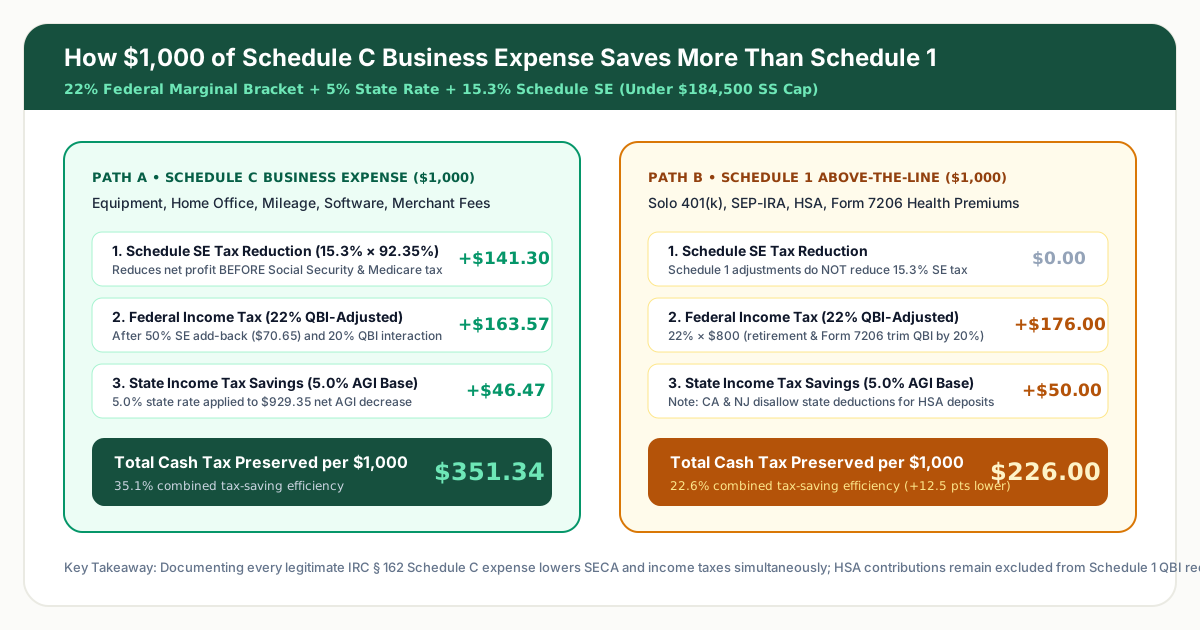
Home office deductions flow through Schedule C Line 30 before Schedule SE
$1,503.17 federal (22% QBI-adjusted) + $422.77 Illinois (4.95% flat)
Zero depreciation recapture applies because Sofia rents her residence
1099 Freelance Tax Estimator
Input either your Simplified ($1,500 max) or Form 8829 actual home office deduction into the estimator to quantify your exact SE and income tax reduction.